|
Fan Shaochang, the Air Force Martyr of Yanqiao, Wuxi Author by William Tang
The War of Resistance Against Japanese Aggression entered a stalemate phase, with China’s airspace and territorial waters almost entirely controlled by the Japanese army. Strategic materials could only be transported into China from the Sino-Myanmar border. At this time, a plan to train Chinese aviation personnel in the United States was implemented. Over the years, hundreds of young Chinese went to the United States in batches to receive fight training. After completing the training, the pilots returned to China to participate in the fight against the invaders. Unfortunately, some of the Repubic of China Air Force cadets died in various accidents during their training, and their remains were buried in the American military cemeteries. Ms Li An, the first generation of college students after the reform and opening up, studied in Canada in the 1990s and later moved to the United States, where she worked in the research and development and management of high-tech companies. Li An’s second uncle, Li Jiahe was a third-year physics student at Southwest Associated University when he joined the army in 1941. He went to the United States the following year and never returned. Sixty years later, Li An’s family finally found him at the Fort Bliss National Cemetery in Texas. The family members who came to pay their respects were surprised to find that around Li Jiahe‘s tombstone, there were many tombstones engraved with “Chinese Air Force”. Like his second uncle, these air forces pilots were were lost in the dust of the times. Later, Li An went to pay respect to his second uncle’s tomb and made a vow in front of the tomb: You are all my second uncles, and I must help you find your relatives! Volunteers from home and abroad lent a hand from all directions, and the long-sealed historical data and photos of the Republic of China Air Force’s training in the United States were gradually found. 33 airmen who died in the United States have found their relatives. Li An sorted out the history of the Chinese Air Force’s training in the United States and wrote the book “Searching for Dust-Forgotten Memories”. Craig Fuller of the USAAIR website posted a photo of a plane wrecked shining on the second side of the Bighorn Mountain in Arizona. The pilot of the crashed plane was a Chinese military trainee from World War II named Van Shao-Chang. Volunteers in the Air Force family search group found that Van Shao-Chang’s permanent address is Yanqiao, Wuxi. Wuxi Anti-Japanese War veteran volunteer Yuan Jian and Jiangnan University Jiangnan Zhiyuan Veteran Care Team Zhang Yingfan both found Fan Shaochang’s photo in the Huangpu 18th Class Alumni Directory and searched for other relevant information. It was finally confirmed that Fan Shaochang was born in 1921 in Yanqiao, Wuxi, Jiangsu. After graduating from the Whampoa Military Academy, he was admitted to the 16th class of the Air Force Academy and the eighth batch to go to the United States. He died in a plane crash during training in the United States. His rank was second lieutenant when he died. On June 4, 2018, the WeChat official account of Jiangnan Evening News published an article saying that there were two Chinese Air Force members from Wuxi who shed their blood in the sky and were later buried in the United States. On June 5, 2018, the Jiangnan Evening News published a news report on the front page about the search for relatives, a few days later, Fan Shaochang’s relatives appeared. At that time, Fan Shaochang’s sister, Ms. Fan Kemei, was still alive, 94 years old. Mr. Feng Zhong, the son of Fan Kemei, was a private entrepreneur. Ms. Lu Fengju, the wife of Feng Zhong, contacted the reporter of Jiangnan Evening News. The following is a description of the plane of martyr Fan Shaochang in the book “Searching for Dust-Forgotten Memories “. On the evening of March 14, 1945, Fan Shaochang took off from Luke Airport at 10:45 in his AT-6D(No. 42-85684) for a routine night cruise flight. In the days without the Global Positioning System (GPS), night flights were dangerous and even experienced pilots had to be extra careful. Fan Shaochang took off without hesitation. The expected cruise route was Luke-Yuma-Belize-Luke. The departure was half an hour later than the scheduled time, and no abnormal situation was reported. Shortly after takeoff, the plane lost contact with the ground…When the search team found the wreckage on the slope of Bighorn Peak, it was around 4 pm on March 20, 1945. The wreckage was scattered for more than 60 meters, and the left wing had dug a deep hole in the ground, which showed that the plane rushed towards the hillside with great force. No mechanical failure was found, and the pilot had not communicated with the tower. There was no black box on the plane at the time. Was the accident caused by the plane itself? Or was it caused by the pilot? I have no comment. The “Aircraft Accident Report” also shows that there was a drizzle in the sky that day. I wonder if it affected the visibility in the sky and caused the plane to crash into the mountain? Later someone found a report in the English-language Arizona Daily News on March 21, 1945 about the plane wreckage at Luke Airport, but the cause of the accident was not mentioned in this report. In May 2019, a group of relatives of Chinese Air Force martyrs from all over China came to the United States to pay tribute to the martyrs, led by Ms. Li An and others. On the way, they were warmly welcomed by Arizona Chinese History Association and representatives of the Chinese community held a welcome dinner for them at the Phoenix Great Wall Restaurant. On the morning of May 15, 2019, a Chinese Air Force family memorial group and members of Arizona Chinese History Association board of directors visited the Thunderbird Academy (former Thunderbird Air Force Base) in Glendale and were warmly received. Feng Zhong, one of the family members who was looking for his relative, touched the wreckage left by his uncle Fan Shaochang’s plane crash and was so excited that he burst into his tears. Crag Fuller, the aviation archaeologist mentioned above, broke off a piece of the wreckage that had been preserved for more than 20 years and gave it to Feng Zhong as a souvenir. Feng Zhong took it back to Wuxi to show his mother. Fan Shaochang’s name has been engraved on the Nanjing Anti-Japanese Aviation Martyrs Memorial, and his permanent resting place is Fort Bliss National Cemetery in Texas, U.S. People on both sides of the ocean will remember him.
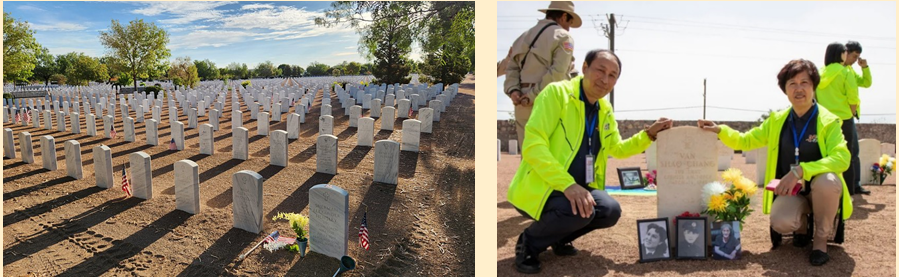
Fort Bliss National Cemetery in El Paso, Texas. Front from left to right: Feng Zhong and his wife Lu Fengju(Wikimedia Commons)
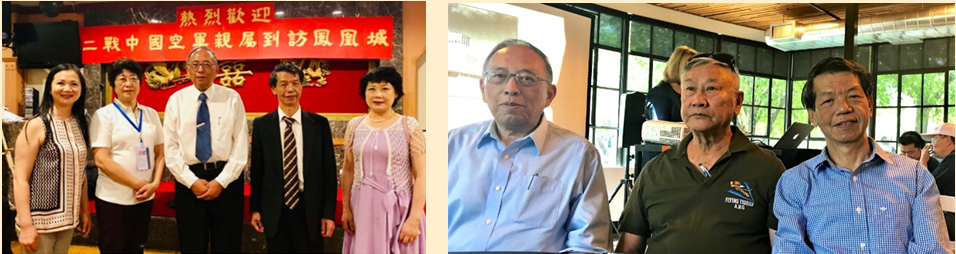
Warmly welcome to relatives of Chinese Air Force martyrs to Phoenix ! From left to right: William Tang (vice-president), Dennis Yee (secretary-general) and Homer Zhang (president) of Arizona Chinese History Association
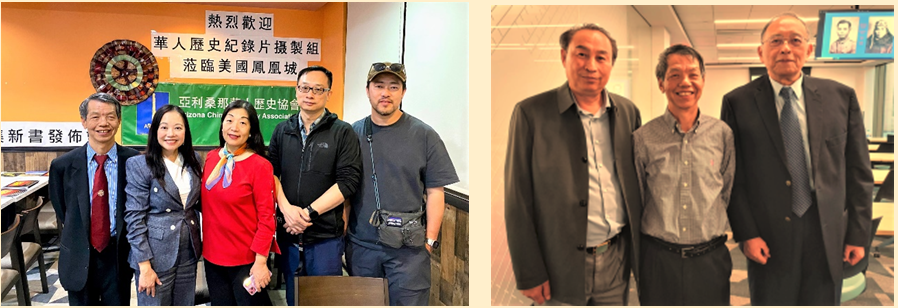
Warmly welcome to Chinese history photography team. From left to right: Feng Zhong, Homer Zhang and William Tang
|